

An AI agent inside your pre-sales team
The AI agent that answers tenders with you.
TITAN reads your files, builds the strategy and writes alongside your team. Installed on your premises, connected to your AI infrastructure.
30 minutes · you choose the content: overview, demo, or a review of your file · no commitment
diagnostic, delivered
in one pass
cognitive pipeline
3 minutes to understand
Watch TITAN at work.
A complete tender, from the submission pack to the technical response: reframing, analysis, strategy, drafting and review.
What goes on in your teams during a tender
"We won't be ready for the submission deadline in two weeks. The teams are saturated, losing track of dependencies between documents. We're in firefighter mode."
Three observations we hear week after week in eligibility calls. Chances are you have already said them yourself.
« 15 tenders in the pipeline, not enough resources. I know we'll lose half. Over €1M in unrecovered bid costs… »
« A serious tender costs me €60K in-house. I have 30 a year. If I lose one in three, that's €600K of wasted budget. I can no longer justify it to the board. »
« A competitor half our size just won a €4M tender we thought was ours. Their proposal was better written. We lost by 0.3 points on the technical score. I can't get over it. »
Here's how it became possible.
Why TITAN is different
An AI agent at the strategic crossroads of four rare competencies.
Bid management, public procurement ontology, cognitive sciences, multi-agent orchestration: four distinct bodies of knowledge. Their crossing is rare — that's what changes the nature of the deliverable.
Bid management, pre-sales IT, consulting and project ownership. Ten years of public tenders won and lost.
Public procurement ontology, business reference frameworks (CCAG-TIC, OEPMA, PSSI), scoring mechanics.
Cognitive multi-agent architecture, precision prompt engineering. Compatible with all premium models.
Psycholinguistics, semantics, neuroscience of reading. What an evaluator remembers and forgets.
Here is how each of the promises at the top of this page becomes possible.
The life of a bid
The life of a tender, with and without TITAN.
Same bid, same deadlines, same stakes. On the left, the response as it is built today. On the right, the same response with TITAN alongside your teams. At each step: what changes, and what comes out.
Receipt
~6 wks before submissionThe DCE lands. 600 pages the salesperson works through alone, between ten other bids, while hunting for an available bid manager. Time runs out, the bid sits idle.
From the moment it is published, TITAN has digested the entire DCE. It delivers usable summaries and a first draft of the technical proposal, already aligned with the scoring grid, the mandatory response framework and the essential requirements.
◆DCE summaries + technical proposal draftQualification
≈ D+7The qualification review takes place with the salesperson alone. The decision to bid rests on past contracts and a gut feeling. What the client really wants? An assumption, never verified.
The strategy is already set. The value proposition no longer rests on the idea you have of your own capabilities, but on what the bid reveals about the client's wishes and fears. You know what to write — and the work is shared out that same day.
◆Strategy note + value propositionStructuring
The bid manager arrives after the fact and has to assemble a team; meanwhile, nothing moves forward. Everyone reads the bid in their own corner. The bid board is makeshift, half tracked, the plan is not settled, and the scoring criteria are never made explicit to the writers.
The whole team relies on the same agent from the outset. The plan is set, the scoring criteria explicit, the dependencies between deliverables traced. The response structure exists before the first line is written.
◆Response plan + scoring/compliance matrixWriting
Writing advances in fragments. No one has the full picture; the dependencies between sections are mishandled. To save time, bits of old bids are pasted in — comparable or not. The bid manager, pulled by other deals, no longer holds the consistency together.
The document updates continuously, and consistency between sections is checked at all times. Within a few days, the skeleton of the technical proposal stands up. Reusing an old bid? Submitted to the agent, which decides what is transposable and what must be set aside.
◆Living technical proposalThe questions that matter
We investigate, we imagine, we debate a solution that the client has, in reality, already defined in the DCE. The real questions — the ones that cannot be guessed — are never asked.
Once 80% of the work is done, TITAN asks the questions it cannot infer on its own: financial data, staffing plans, location constraints. You collect what is missing, you stop inventing.
◆Data collection formPricing
BPU · DQEHours are spent decoding the price scoring system, building staffing plans by hand, varying every last ETP to measure its effect — without ever being sure of the break-even point.
TITAN analyzes the BPU/DQE structure and the criteria: weightings in multi-criteria scoring, the slope of the price scoring curve. It helps build a pricer, generates dashboards wired to the right sources, runs the scenarios — one adjustment per assumption — and produces the review reporting.
◆Pricer + scenario dashboardsReviews
The review is prepared by hand, on an old template recovered from a previous bid. A fixed checklist is run through; the audience's remarks go into a report that no one really feeds back in.
The agent builds the review with the bid manager: it challenges them, prepares the questions, validates the consistency of the solution, the completeness of the document, the clarity of the message. After the review, it applies the audience's actions almost directly into the technical proposal.
◆Review deck + actions applied to the MTProofreading & submission
D-7 → D0A few days before submission, last-minute reviewers — sometimes a copy-paste into ChatGPT — surface gaps. Too late: not enough people, budget or time left to address them. The bid manager has no mental space left. We submit and cross our fingers.
Time is freed up for what truly matters: proofreading and strategic reorientation. Consistency is held end to end. We submit on time, without a final scramble.
◆Strategic reviewThe oral defense
after submissionWe wait for the client's agenda. In the meantime, we polish the bid blindly, with no idea of where to focus the effort.
Starting from the value proposition, TITAN infers the awkward questions, helps build a visual and dynamic deck, and challenges the speakers in rehearsal.
◆Anticipated jury questions + defense deckOne agent, three roles.
At every step, TITAN simultaneously holds the three positions that make a winning response:
Three rare areas of expertise, brought together in a single agent — on everyone's desk.
The result
« TITAN allowed us to stay focused on the high-value scoring units, and to adopt a coherent response strategy. »
« After three weeks of writing, no one has the distance left to dissect every sentence. TITAN, an operator of clarity in the service of a limpid argument. »
« TITAN played the role of a true Exec reviewer. It tracked the compliance of each of our deliverables, and corrected several editorial drifts before submission. »
Architecture · what makes all this possible
A real autonomous personal agent, installed on every team member's workstation.
TITAN is not a chatbot in a browser tab, nor a platform shared in the cloud. It is an AI agent that installs on the machine of every solution architect, bid manager, reviewer, or pre-sales engineer engaged on the project. One TITAN per user, configured for their role, connected to their knowledge bases, synchronized with the tender project. Your teams take back control only at the strategic milestones.
Runs as a desktop app or local MCP server, as many instances as users on the project. Documents never leave the workstations unless you wish. No upload, no copy at our end, no silent siphoning to a third-party cloud.
Each member's TITAN reads their Documents, OneDrive, synced SharePoint, Drive directories, builds on their past tenders, their technical memo templates, their CV references, their BPU, their win themes. On a shared tender, the agents sync at the project level — each keeps their context, the bid manager sees the overall coherence.
Each TITAN runs through the 12 pipeline phases in near-autonomy on the portion of the file entrusted to its user. You take back control at the strategic milestones: shaping, positioning validation, briefing the architects, final review. The rest unfolds without soliciting you at every step.
Under the hood: MCP protocol (Model Context Protocol) — open standard for agent ↔ tools ↔ files interaction, which makes autonomy possible without cloud siphoning. Compatible with all premium LLM models (Claude, GPT, Gemini, Mistral) and with Claude Code, Cowork, Cursor, GitHub Copilot, Codex for teams already equipped — you remain in control of the engine. No lock-in, no imposed pricing changes, no constraints from a single vendor.
Three possible states, you choose
The same team, three trajectories. One of them is yours in six months.
- •Win themes and ghost themes not defined upstream
- •CCTP ambiguities left to each person's interpretation
- •Solo writing, with no intermediate strategic review
- •Compliance spotted the day before — or never
- •4-week sprints to string together with no respite
- •Conversion rate stuck at 20-25%
- •Multi-million tender lost by 0.3 points of technical score
- •Board asking ever more with ever less
- •Every CCTP requirement read, every weak signal raised
- •Writing guided and challenged from start to finish
- •Compliance and blind spots tracked before submission
- •Exhaustive, defensible, coherent file end to end
Why not ChatGPT, not a SaaS, not a consultancy
The three alternatives to TITAN and what they cannot do.
You will understand why bid managers who had tried the three other options end up calling us.
Standard tools are deliberately limited by a token window (working memory) that is ridiculously low. It doesn't even allow proper coverage of a 2-hour meeting transcript. On a €4M tender, that's putting a city car hose on a racing engine. It holds for two minutes, it gives out at the third corner.
The universal Swiss army knife, not designed for IT tenders.
- ✕CCTP paragraph traceability — hallucinates
- ✕Business vocabulary CCAG-TIC, OEPMA
- ✕Multi-deliverables MT / CRT / PAQ / BPU / CV
- ✕Step-by-step accompaniment
- ✕Sovereignty outside US cloud
- ✕Cross-tender capitalization — no memory between conversations
Clean writing tool, but stops at the memo.
- ~Partial traceability
- ~Basic business vocabulary
- ~Technical memo only
- ✕No accompaniment, just an editor
- ~Variable sovereignty
- ~Cross-tender capitalization — static template library
Human know-how, by the billable day.
- ✓CCTP paragraph traceability
- ✓Mastered business vocabulary
- ✓Multi-deliverables covered
- ~Accompaniment depending on billed days
- ✓France sovereignty
- ✕Very expensive — high bid costs on every file
- ✕Cross-tender capitalization — impossible by construction (external party)
The expertise of a consultancy, at the scale of software, on your infrastructure.
- ✓CCTP paragraph traceability
- ✓Business vocabulary CCAG-TIC, OEPMA, PSSI
- ✓Multi-deliverables MT / CRT / PAQ / BPU / CV
- ✓Accompaniment from reading to oral defense
- ✓France sovereignty, deployment on your workstations
- ✓Cross-tender capitalization: every file feeds the next
Field validation
Validated in real conditions on multi-million euro files.
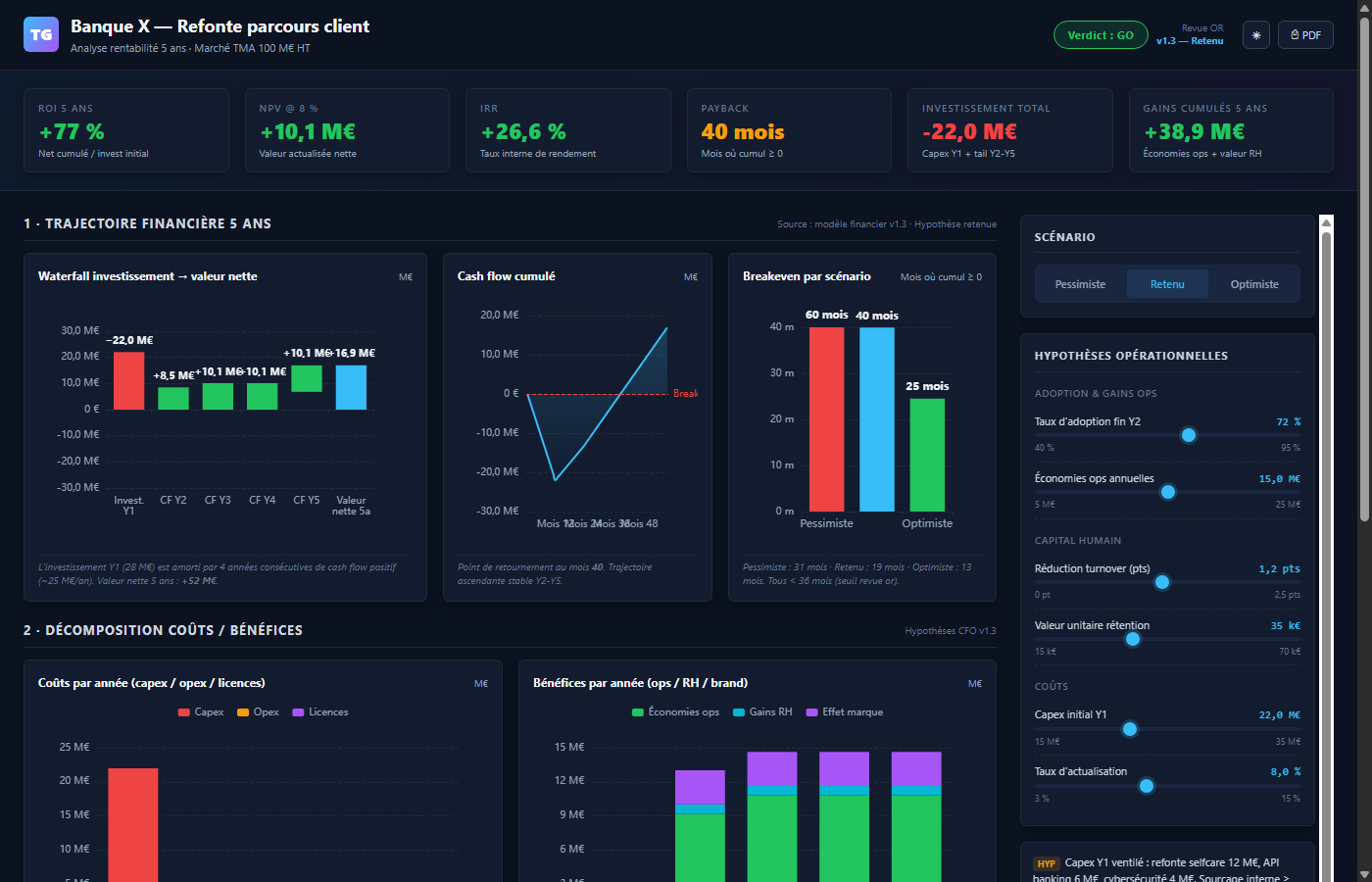
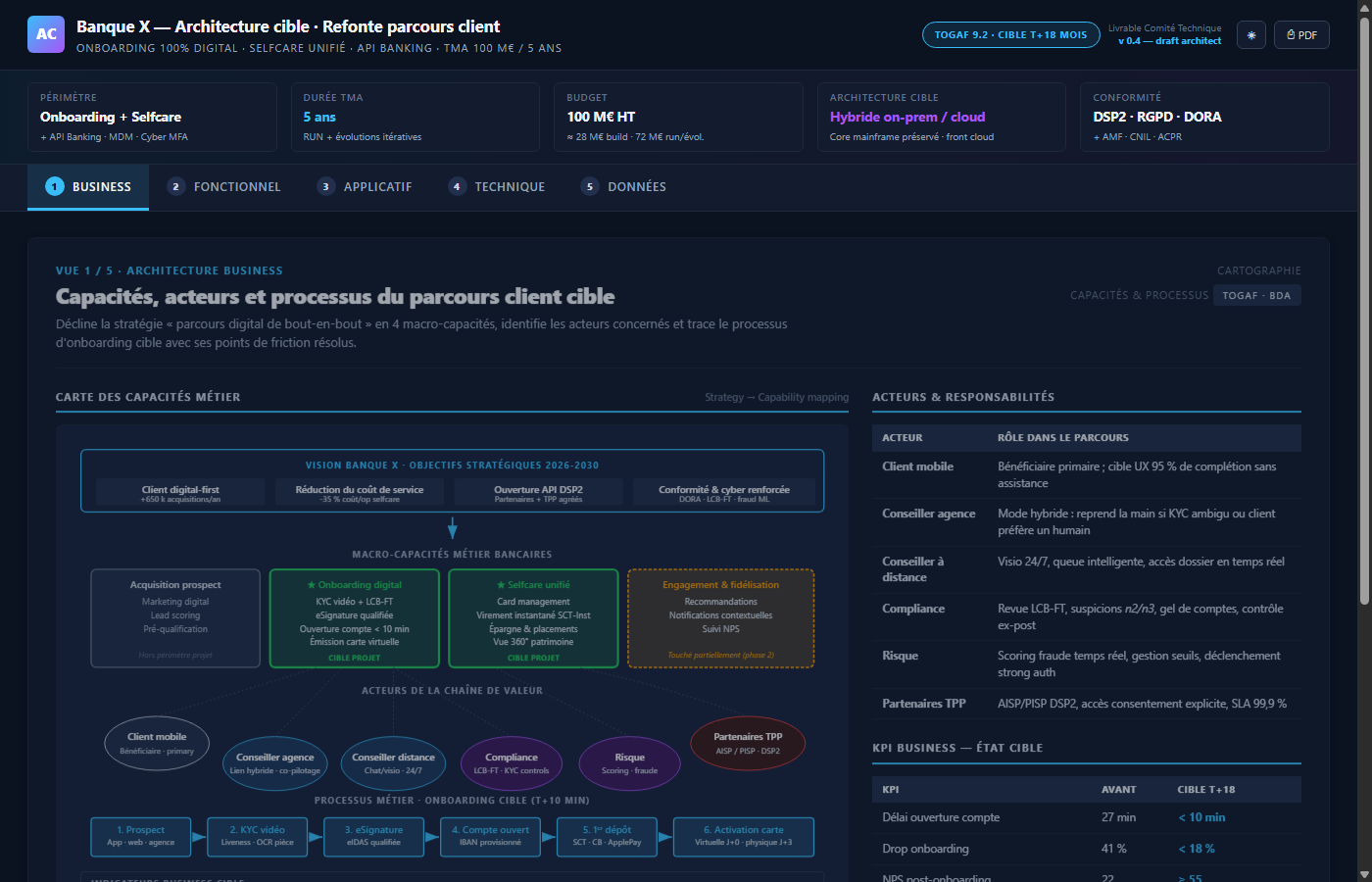
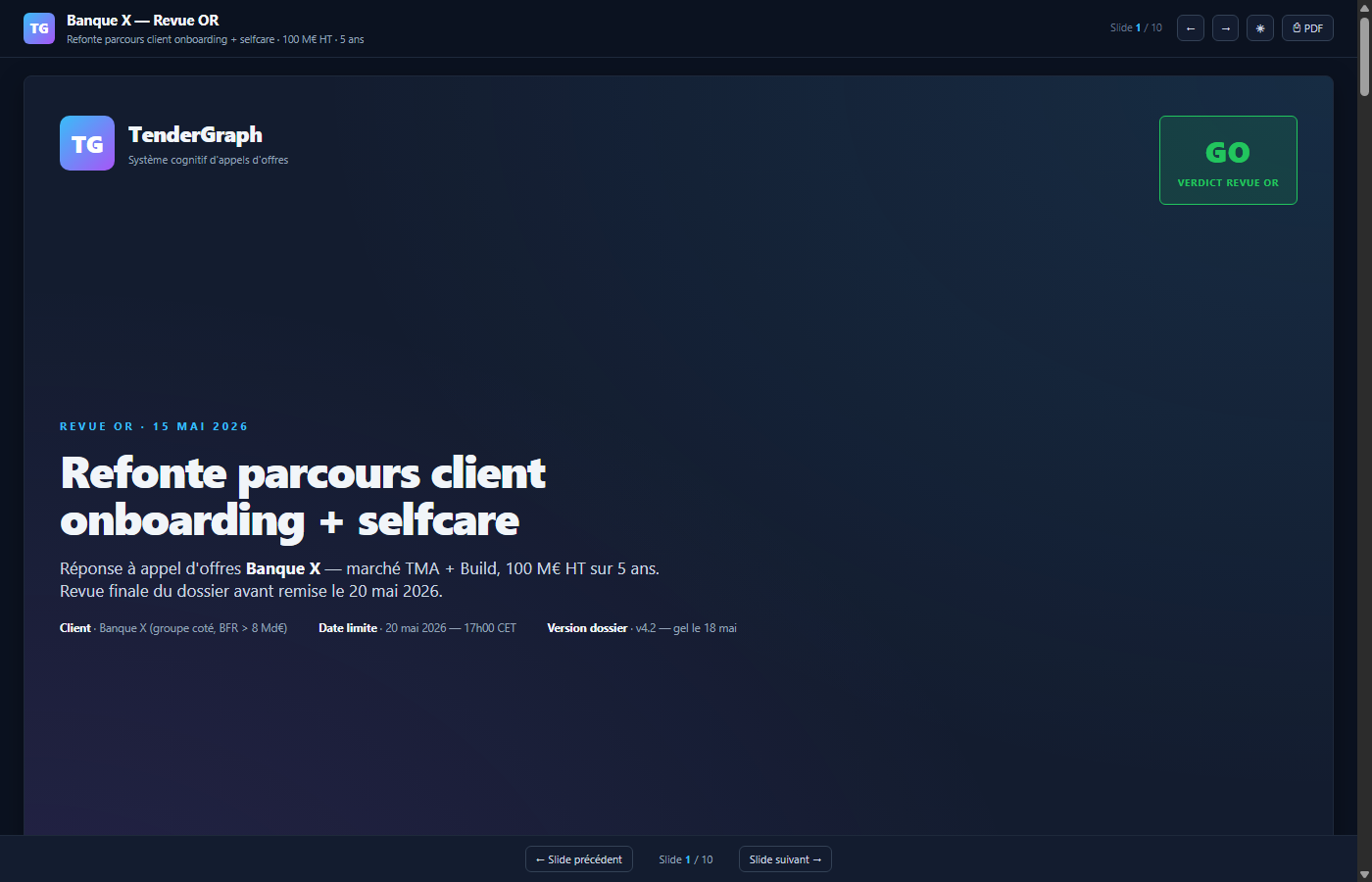
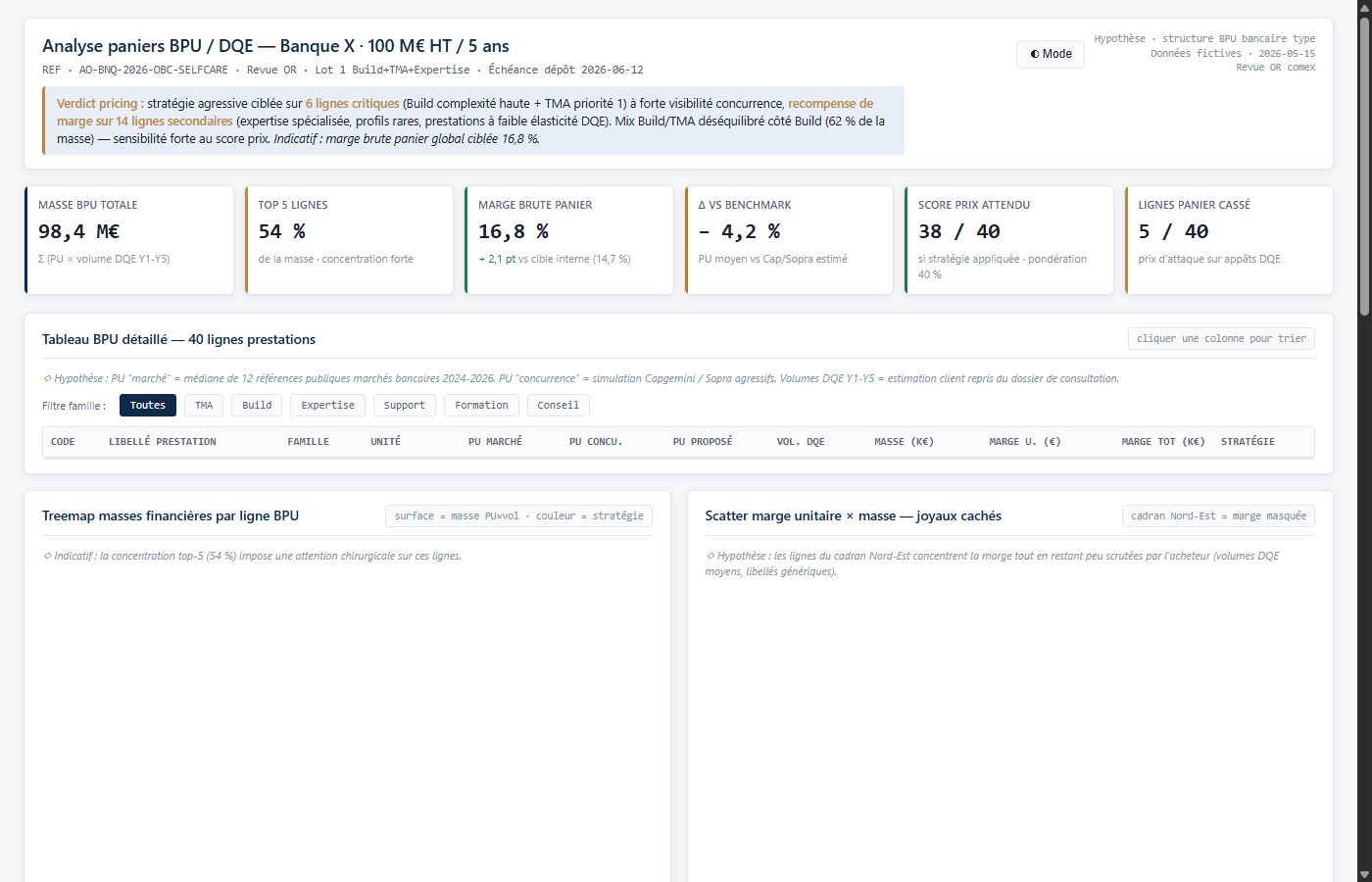
Click on a deliverable to open it interactively. Real anonymized client case — banking market €100M HT over 5 years.
An extremely relevant analysis of the client and the value proposition. TITAN was able to grasp signals that had escaped our commercial team and proposed a solid positioning base.
Unlike our previous chatbot, TITAN reads the latest version of our documents directly, without time-consuming copy-paste, and proposes structural modifications. Finally an AI agent that actually works, for bid management.
The origin of the method
Three bodies of knowledge already existed. The binder was missing.
Senior bid management, public procurement ontology, language sciences. Three disciplines that have existed for a long time, never brought together on 500 pages of DCE in a single response.
No expert holds the three durably. The best rely on heuristics — knowledge acquired through pure experience, never formalized. It is a cognitive limit, not an expertise limit.
A new generation of AI agents now crosses that limit. TITAN mobilizes its power in respect of the teachings of these disciplines. It thereby reaches an analytical and judgmental capacity that no one else on the market can match.
Your collaborators benefit from it directly.
A meeting to check if your project is eligible for TITAN.
A structured exchange, with no commercial pressure, to qualify your pre-sales context, identify the tender scope where TITAN will deliver the most value, and debrief the critical audit of your last tender response. If we are not the right partner for you, we will say so.
The final questions